
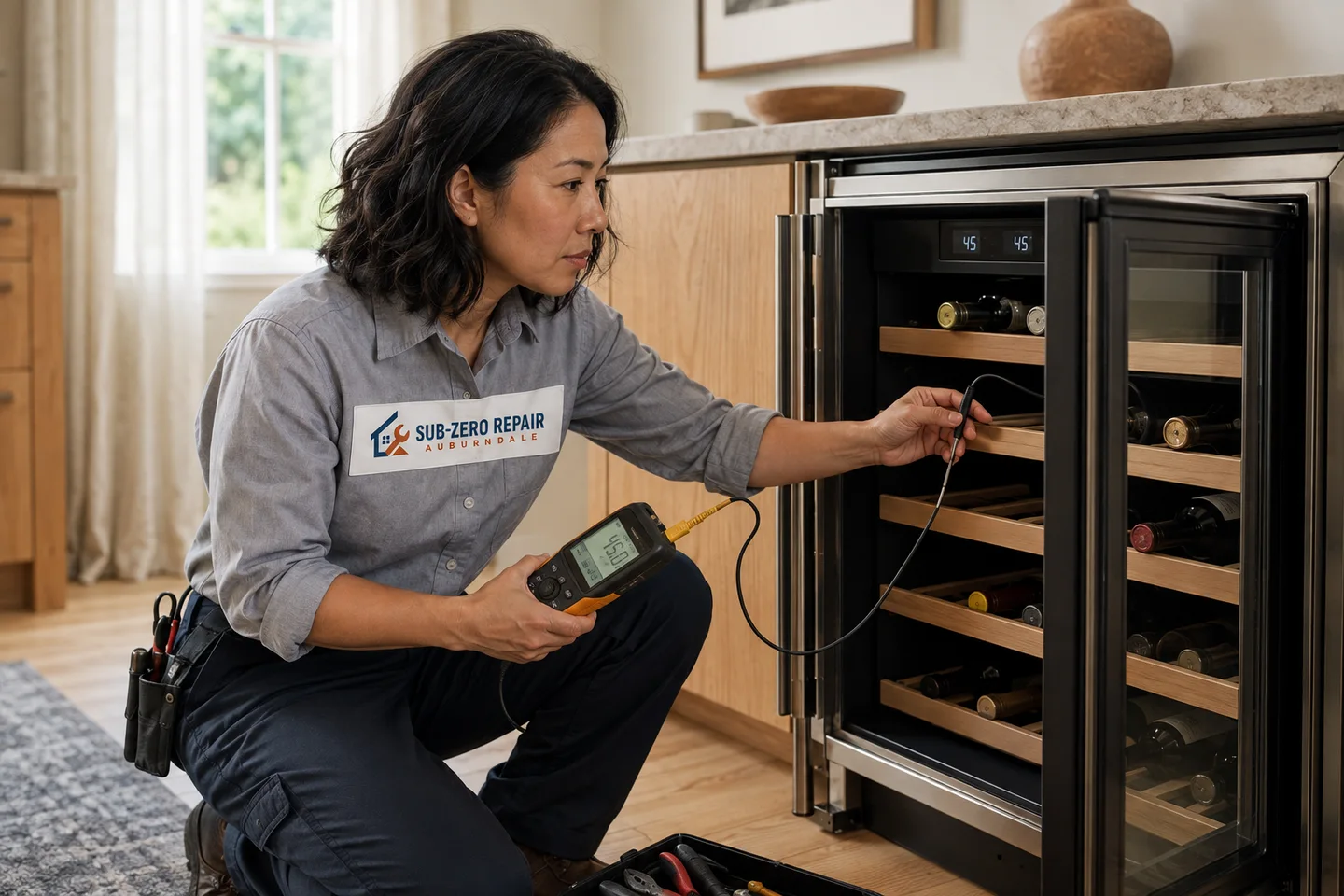
Sub-Zero wine appliances have their own controls and storage arrangements; they should not be assessed as ordinary food freezers. We service residential Sub-Zero wine storage in the Auburndale area and begin with the symptoms, the exact model and the way the unit is installed.
Separate a display setting from actual storage conditions
Record the selected temperature and, if available, a separate measured temperature. For a multi-zone product, note which zone has changed. Do not assume that two compartments should behave identically: the intended arrangement and control options depend on the specific model. A complete model label is more useful than the number of bottles the cabinet holds.
Let us know whether the change is continuous or appears after loading, opening the door or using another appliance nearby. Frequent adjustments make a trend harder to interpret. Preserve a simple record of the problem and avoid using a food-freezer setting as a reference for wine storage.
Look at the door, racks and surrounding cabinet
Bottles or racks that prevent the door from fully closing can affect conditions inside the unit. Check for an obvious obstruction without changing hinges or forcing a rack. On custom-panel installations, the relationship between the appliance door and surrounding furniture can also matter.
Tell us whether the unit is a tall column, an undercounter model or a combination wine-and-refrigeration appliance. Service access and component selection differ. A photograph of the overall installation is helpful when the cabinet is fitted closely beneath a counter or beside another column.
Noise is worth describing precisely
A rattle when a rack is loaded, a buzz from the cabinet and a new mechanical sound during a cooling cycle point the investigation in different directions. A short recording can capture an intermittent sound, provided you do not remove panels or reach into the appliance to obtain it.
Note whether the sound changes when the door opens or when a nearby cabinet is touched. Avoid wedging materials against a moving appliance or adding insulation over ventilation openings. The aim is to understand whether the source is a loose item, installation contact or an operating component.
Protect the collection while the cause is assessed
If the cabinet is no longer maintaining stable conditions, consider a suitable alternative storage location while service is arranged. Limit unnecessary openings and avoid exposing bottles to sudden changes merely to test the appliance. Do not place heaters, fans or ice packs inside as an improvised repair.
Water near the unit should be treated as a separate observation and reported along with the temperature complaint. Dry the accessible floor safely and keep moisture away from power connections. A photo of the first wet area can be more useful than a general description of a leak.
Diagnosis before replacing expensive components
Depending on the symptoms, inspection may consider door contact, airflow, temperature sensing, fan operation, controls and refrigeration performance. A warm zone does not automatically mean that its sensor is the only fault. The technician needs to connect the measurement to the actual operating behavior.
Our standard diagnostic visit is $150; repair pricing follows the diagnosis. Parts and return-visit requirements depend on the model and findings. Call 857-376-4770 with the model, affected zone and location in your home to request an appointment.
Questions before your visit
Yes. Include the model and explain whether it is beneath a counter or fitted with a custom panel. Please leave it installed until service access has been discussed.
No. Temperature, door closure, airflow, controls and refrigeration performance all need context. The proposed repair follows inspection rather than an assumption based on one symptom.
Product reference: use the complete model number to find the correct owner guide. Manufacturer information does not imply affiliation with this service.
Sub-Zero official product and owner information ↗